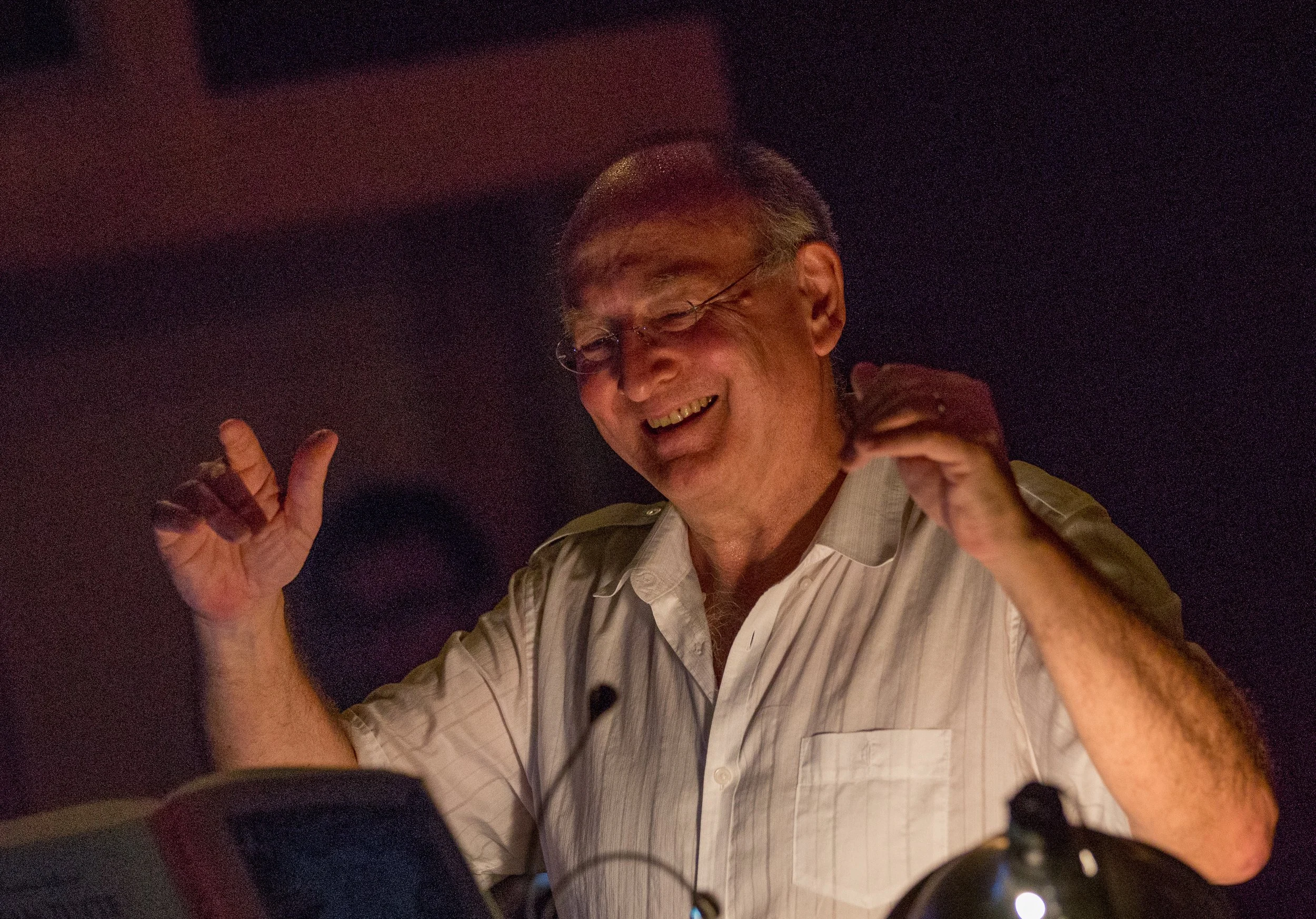
About
My earliest musical memory is having a little record player that could play 45rpm singles. I saved up to buy the record of Elvis Pressley singing “You ain’t nothin’ but a Hound Dog” and played it often. When I was 5, a door-to-door salesman came knocking, selling accordions and “testing” children for musical talent. I was deemed to have some, and my parents bought the accordion. Shortly afterward my (much) older brother gave me a recording of Bach on the harpsichord which I played on repeat and asked to graduate from accordion to piano lessons.
Entering the University of Washington school of music at 17 provided the playground I needed to major in composition, study harpsichord and wait for my rock and roll band to become famous. That band provided the impetus for songwriting because we were always in need of new material. It also provided me with a musical partner, Allen Sanders, who gave me my education in blues and jazz and taught me to admire the broad panorama of black musical artists from Thelonius Monk to Jimi Hendrix.
At that time (late 60’s), classical vocal technique seemed worlds away from the more “natural” singing I loved and aspired to emulate. Then, at first through madrigal groups and choirs, I began to hear a vocal approach which seemed much closer to that aesthetic. The cello professor at the University was from Germany and played the viola da gamba. She had brought a lute with her from Germany – and when I expressed interest, she lent it to me to learn. As soon as I could manage the accompaniments, I found singers to sing lute songs with me. After a while I realized that my band was not going to become famous, and that the University had no resources to bring me further with the lute.
I decided to go to England, where I managed to get lessons from the pre-eminent Dowland expert, Diana Poulton, and the lutenist and singer Robert Spencer. A whole world of dedicated practitioners of “early music” opened up to me and eventually led me to work with the Hilliard Ensemble, and a further extension of that with tenor, John Potter and what ECM’s Manfred Eicher decided to call The Dowland Project.
In the 80’s I moved to Germany where after “gigging” as a lutenist – including exciting opera projects with Alan Curtis in Italy and William Christie in France, I decided to found my own ensemble called Tragicomedia. We established ourselves as a continuo ensemble (lute, harp and viola da gamba) which allowed us to choose our favorite singers and instrumentalists to play with. At the same time I was named the professor of lute and performance practice at the Hochschule in Bremen.
In 1995 I was invited to join the orchestra of the Boston Early Music Festival to perform Luigi Rossi’s Orfeo. Making common cause with fellow-lutenist Paul O’Dette, we became artistic co-directors of the festival in 1997 – and have continued until the present.
One other significant adventure for me, beginning in 2007, was moving to my hometown of Seattle with my wife, baroque harpist Maxine Eilander, and establishing together a new concert series and ensemble called Pacific MusicWorks. When we moved away from Seattle in 2019 we suspended the annual series, but continue to concertize with the core ensemble and profit from the wonderful projects and artistic relationships built there over more than a decade.